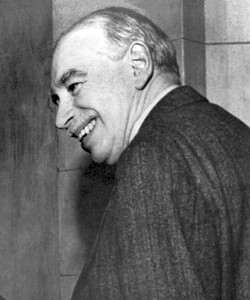
Having recently reread Richard Heilbroner's hoary old monograph, "The Worldly Philosphers", I come armed with wisdom for these bleak economic times, not unlike Don Quixote, astride his faithful Rocinante.
Perhaps at the end of the day, historians of economics will come to view John Maynard Keynes as the Einstein to Adam Smith's Newton. Undoubtedly Smith's law of supply and demand will always enjoy the central stage of economics, just as Newton's laws of motion do for physics. But might I gently remind the dear reader that Newton's laws are wrong (however undetectable that may be for human speeds and masses). So too, Keynes found major flaws in the optimistic dynamics and equilibrium implied by Smith, and hence could be the most important and consequential economist since.
Perhaps the key to his work lies in the re-conception of savings. For a long time, the saving of money was considered an unmitigated private and public virtue; a habit that redounds multipliers on the foresighted family or state, without a doubt.
Not so for Keynes! The act of saving, removes wealth from circulation. That money under the mattress is no longer spent on goods and services that contribute to someone else's income. That someone else, too has less income to spend, so the effect multiplies. If everybody stashes too much of their earnings, the national income plummets and a depression sets in.
"Wait wait," you say, "Now just how does depression settle in so comfortably and uninvited?" Well I ask you to consider the lowly widget factory: The widget factory sees a drop in demand, because people have decided to save their money rather than spending it on widgets. So the factory is forced to lay off some of its employees and cut the pay of still others. Moreover, in order to make ends meet, the CEO decides it is necessary to reduce investment in promising new widget technologies, especially considering that it is unkown how long this savings binge will last. This contributes to a general decline in investment which throws the investment-savings differential still further out of whack and the wheels come off of the economy as it loses its unplanned Smithian efficiency. Prices and inflation rise and all hell breaks loose, in the academic vernacular.
Hence we come to the Bush Administration's much maligned encouragements after 9/11 to go out and spend money. Perhaps this was a strange thing to say at the time, but it was rooted in a belief in Keynesian economics: that a sudden clenching of the pocketbook might lead to depression.
So stashing money under the mattress is a surprisingly bad thing indeed. Tisk tisk! But not quite as bad as all that, is putting it in the bank. The bank takes your money quite happily and lends it out as new investment capital, with interest. Thus, your money finds its way back into circulation, and joins the happy cycle of income to income, and all is well with the world.
Or is it? What happens when there is too much money in the bank? There are simply not enough investors applying for loans. What if the differential between investment and savings is huge and sudden? Pop! The bubble bursts. National income plummets and depression sets in. So even with the cool invention of banks, trouble can be had under the right circumstances.
"Okay, but could this actually happen?" says my imaginary reader; the one who, for some strange reason, has not yet wandered over to her Google, Facebook or Twitter account. Well Keynes says it can and does happen. Growth happens in spurts as new markets rapidly mature and saturate. Take the internet for example. The bubble burst in the late 90's as there was an over-investment in fiberoptic cable and the market saturated. Investment dropped precipitously as there was no longer any reason to lay new cable. This is a repetition of what happened with railroads, autos, and other markets.
So what is to be done? Are we fated to suffer the indignities of boom and bust? Besides not having a clue, this post is getting long in the tooth, so lets save it for the sequel. Anyways Rocinante is getting thirsty.


 Posts
Posts


2 comments:
I don't subscribe to the widget factory as described, bit too contrived. Very Western and consumerism heavy.
Who says one can just waltz into the model and say people start saving and factory sees drop in demand. Any widgeteer accepts from the start, if they believe in Smith (more aptly, should be referring to Ricardo however), that supply and demand WILL fluctuate, perhaps radically, and that widgeteers will come and go. Knowing that suggests that a widgeteer should build flexibility into the operation to ride with fluctuations. A spike in demand shouldn't spur expansion that is then ready to collapse when a demand downspike occurs. Expecting only growth and never contraction is foolishness.
Why does the factory have to lay off workers to cut costs? Because during WWII in the US, a norm started where firms provided social services/benefits, which are supra expensive. Who says this has to be? Why would a CEO reduce technology investment? Widgeteers that succeed transcend current demand by innovating and creating what people think they NEED. The whole purpose of marketing is to convince people that there are things they DO need, i.e. create demand; thus marketing business at least should grow in downturns because customers are more scarce. There's a lot of contraption that has been rigged up but it doesn't mean we have to accept it as legitimate, nor expect that we can necessarily model or predict it accurately. Moderation in all things, including widgeteering, seems like good simple philosophy to me.
The problem is that there is no natural incentive for savings to balance investment. A social tendency to save is not going to be affected greatly by the contraction in investment that occurs as a particular market saturates. In fact the danger of imbalance is more acute during strong economic expansion, when the most likely outcome of excess income is a savings glut. Hence the boom-bust cycle.
Everything can be okay, provided that as one market saturates, there is another entering its growth spurt. For example, you might have the internet saturating in the late 1990s just as cellular networks are taking off. In another case you might see a slack in new power generation capacity compensated by a spurt in new automobile plants.
Post a Comment