Recently the Wall Street Journal argued that all social legislation should have bipartisan support in Olympia Snowe is Right. They cited the precedents of Social Security, The Civil Rights Act and Medicare (lets call them the Big Three) which did indeed receive support from Senators of both major parties. Let's set aside the fact that they gave no reason why such a gentleman's rule might be in order -- for if it does have good reason, then it would be simple enough to install it in the official rulebook at the beginning of the Congress' term.
The WSJ's argument reminds me of the anthropic principle in cosmology, in which it is observed that the physical constants of the universe are "uncannily" tuned so that life can exist. Author Paul Davies coined it the "Goldilocks Enigma." But many physicists have pointed out that it is not such a coincidence. If it were any other way, they say, we would not be here to make the observation in the first place.
So it is with the great social legislation of the 20th century. From 1917 until 1975, cloture required two-thirds of the Senators -- or 67 in today's Senate. Thus is it no great surprise that major bills during this period like the Big Three were passed with some bipartisan support. Has one party ever controlled two-thirds of the Senate? I doubt it. In effect, bipartisan support was mandated by the rules of the Senate, the "world's greatest deliberative body," as the WSJ reverently calls it
But consider for a moment The Civil Rights Act of 1964. Jim Crow, empowered by Plessy v Ferguson (1896), stood tall for 68 years before enough bipartisan support to sink him could be retained. By their logic, this was as it should be. Perhaps the Senate's rule change in 1975 to reduce the cloture threshold to 60 is an implicit recognition of the shortcomings of bipartisanship.
And as I review the bipartisan legislation of recent memory, I am not always overwhelmed by its wisdom. To be sure there were good bills, but two particularly bad and consequential ones cry out. The Senate voted 95-0 against Kyoto in 1997 and 77-23 for the Iraq War in 2002.
Thursday, December 17, 2009

Wednesday, August 26, 2009
The Legend Dies
Much has been on the airwaves on Senator Ted Kennedy today. As I was finishing my daily reading on the WSJ, I came across this statement:
Over the course of the third-longest tenure in the history of the Senate, Mr. Kennedy mounted a legislative agenda across a wide range of issues dear to liberal voters and left-leaning Democratic Party constituencies -- school and racial integration in the 1960s, poverty and gender equality in the 1970s, disability in the 1980s and education reform in the 1990s.
I never considered myself liberal or left-leaning before. But by golly, if being left-leaning is to champion the above list please call me a lefty by all means!
Over the course of the third-longest tenure in the history of the Senate, Mr. Kennedy mounted a legislative agenda across a wide range of issues dear to liberal voters and left-leaning Democratic Party constituencies -- school and racial integration in the 1960s, poverty and gender equality in the 1970s, disability in the 1980s and education reform in the 1990s.
I never considered myself liberal or left-leaning before. But by golly, if being left-leaning is to champion the above list please call me a lefty by all means!
Sunday, August 02, 2009
Healthy lessons from abroad
This morning Senator McCain observed that while everybody agrees that health care costs are too high, the difference between the parties is that the Republicans believe that the US has the best quality health care in the world. As an aside, this highlights a deeper problem within the Republican Party: the blind devotion to the principle the US is in every way the best country in the world. That leaves comparative analysis to the "America-haters."
Stipulate for the moment that there may or may not be lessons to be learned from foreign health care systems. Put on your agnostic cap and defer any notions you may have about single payer, socialized health care, public options, etc. Meditate if you have to.
Having thus prepared, we can ask the key question: Are there any systems that cost less while delivering more? If there are, we can have a closer look. If not, then we can move on. The following table compares the US with three other countries culled from a Frontline special.
These numbers warrant further interest. Here are three health care systems that provide more coverage for a much cheaper price tag. Not only that, but on the surface they appear to be delivering as good or better health care in terms of infant mortality and life expectancy. Of course these are not perfect indices of health care quality, but they are some of the best metrics available for overall population health, which itself is a function of health care, diet, exercise, air quality and other factors. Indeed, it is reasonable to assume that one of the reasons that the US has lower life expectancy and higher infant mortality is due to the high number of uninsured.
Another way of looking at quality is the degree of access to health care professionals and technology. Japan excels in these ways too. Japanese people go to the doctor three times as often as Americans and they have greater access to medical imaging technology. Although the UK and Taiwan have fewer medical imaging instruments per capita, the UK boasts outstanding preventive care and Taiwan has remarkably low waiting times and other barriers to seeing medical professionals. The US health care meanwhile is characterized by long waiting times and lack of continuity. In one Commonwealth Fund study of patients above a certain sickness threshold, the UK did considerably better in terms of wait times and continuity. This in spite of the fact that socialized health care systems rightly or wrongly carry the stigma of patients waiting in line.
Now that our curiosity is piqued, we may wonder how these other health care systems work. Interestingly, Taiwan, Japan and the UK present a variety of approaches to health care.
The UK is the epitome of much maligned socialized medicine. There are no co-payments, payroll deductions, insurance companies, etc. All health care payments are drawn directly from the national tax revenue.
Japan's health care system looks more familiar on the surface. It is ostensibly a multi-payer system with private insurance companies and premiums that are paid by payroll deductions, employer contributions and co-payments. However, universal coverage is mandated and subsidized to a greater extent. The biggest difference is that the government in effect steps in as the single payer's representative and negotiates with the doctors to determine a schedule of fees which is updated every two years. This causes a dramatic reduction in cost and even led to innovation in medical imaging technology. Actually, the problem with Japan's system is that costs are too low.
Taiwan's current health care system is of recent vintage having been comprehensively engineered based on a study of other countries. All health care coverage is provided through a government insurance agency reminiscent of the 'public option' currently being legislated. As usual, one payer means more market power for the buyer. In addition, each patient carries a smart card with their medical history and payment mechanism. Taiwan boasts the lowest administrative costs in the world.
Clearly there are some lessons to be learned from abroad if we can keep an open mind. We needn't resign ourselves to the notion that health care will be ever more exorbitant. The overhaul would have to take place in several steps and would require non-partisan oversight and steering. If the public option is adopted, lower costs would not be evident until the government insurance agency accumulates enough market power.
Stipulate for the moment that there may or may not be lessons to be learned from foreign health care systems. Put on your agnostic cap and defer any notions you may have about single payer, socialized health care, public options, etc. Meditate if you have to.
Having thus prepared, we can ask the key question: Are there any systems that cost less while delivering more? If there are, we can have a closer look. If not, then we can move on. The following table compares the US with three other countries culled from a Frontline special.
| Country | Cost/GDP | Life expectancy | Infant mortality | Universal? |
| US | 15.3% | 77 | 6.8 | no (83%) |
| Japan | 8% | 82.1 | 2.8 | yes |
| Taiwan | 6.3% | 78 | 5.4 | yes |
| UK | 8.3% | 79 | 5.1 | yes |
These numbers warrant further interest. Here are three health care systems that provide more coverage for a much cheaper price tag. Not only that, but on the surface they appear to be delivering as good or better health care in terms of infant mortality and life expectancy. Of course these are not perfect indices of health care quality, but they are some of the best metrics available for overall population health, which itself is a function of health care, diet, exercise, air quality and other factors. Indeed, it is reasonable to assume that one of the reasons that the US has lower life expectancy and higher infant mortality is due to the high number of uninsured.
Another way of looking at quality is the degree of access to health care professionals and technology. Japan excels in these ways too. Japanese people go to the doctor three times as often as Americans and they have greater access to medical imaging technology. Although the UK and Taiwan have fewer medical imaging instruments per capita, the UK boasts outstanding preventive care and Taiwan has remarkably low waiting times and other barriers to seeing medical professionals. The US health care meanwhile is characterized by long waiting times and lack of continuity. In one Commonwealth Fund study of patients above a certain sickness threshold, the UK did considerably better in terms of wait times and continuity. This in spite of the fact that socialized health care systems rightly or wrongly carry the stigma of patients waiting in line.
Now that our curiosity is piqued, we may wonder how these other health care systems work. Interestingly, Taiwan, Japan and the UK present a variety of approaches to health care.
The UK is the epitome of much maligned socialized medicine. There are no co-payments, payroll deductions, insurance companies, etc. All health care payments are drawn directly from the national tax revenue.
Japan's health care system looks more familiar on the surface. It is ostensibly a multi-payer system with private insurance companies and premiums that are paid by payroll deductions, employer contributions and co-payments. However, universal coverage is mandated and subsidized to a greater extent. The biggest difference is that the government in effect steps in as the single payer's representative and negotiates with the doctors to determine a schedule of fees which is updated every two years. This causes a dramatic reduction in cost and even led to innovation in medical imaging technology. Actually, the problem with Japan's system is that costs are too low.
Taiwan's current health care system is of recent vintage having been comprehensively engineered based on a study of other countries. All health care coverage is provided through a government insurance agency reminiscent of the 'public option' currently being legislated. As usual, one payer means more market power for the buyer. In addition, each patient carries a smart card with their medical history and payment mechanism. Taiwan boasts the lowest administrative costs in the world.
| Country | Funded by | Single payer? |
| US | Private insurance | no |
| Japan | Private insurance | sort of |
| Taiwan | Govt insurance | yes |
| UK | Taxes | yes |
Clearly there are some lessons to be learned from abroad if we can keep an open mind. We needn't resign ourselves to the notion that health care will be ever more exorbitant. The overhaul would have to take place in several steps and would require non-partisan oversight and steering. If the public option is adopted, lower costs would not be evident until the government insurance agency accumulates enough market power.
Thursday, July 30, 2009
Maiduguri, Nigeria: The Steeple Bumpleigh Horror II
While a lot of attention these days has been given to the violence in northern Nigeria fomented by a group that goes by the name of Boko Haram, little light has been shed on its seminal antipathy for the fictional character Boko Fittleworth developed by the English novelist P.G. Wodehouse.
Haram is an Arabic term meaning "forbidden," a sentiment that would find a ready ally in none other than Jeeves himself. After Jeeves had met Boko for the first time, Bertie observed that his normally unflappable gentleman's gentleman "winced visibly and tottered off to the kitchen, no doubt to pull himself together with cooking sherry". Bertie once admitted that he wouldn't wholeheartedly recommend meeting Boko, describing him as "an acquired taste...at least that's what his mother says."
But patched trousers notwithstanding, Mr. Fittleworth has never before been known to provoke violence among his detractors. In an effort to staunch a broadening of the movement, the UN Security Council has urged Gutenberg.org, which publishes more than 30,000 free online books, not to release the 1946 novel "Joy in the Morning" and to redact passages in other Wodehouse novels that have already been published on it's website. Gutenberg could not be reached for comment at this time.
Haram is an Arabic term meaning "forbidden," a sentiment that would find a ready ally in none other than Jeeves himself. After Jeeves had met Boko for the first time, Bertie observed that his normally unflappable gentleman's gentleman "winced visibly and tottered off to the kitchen, no doubt to pull himself together with cooking sherry". Bertie once admitted that he wouldn't wholeheartedly recommend meeting Boko, describing him as "an acquired taste...at least that's what his mother says."
But patched trousers notwithstanding, Mr. Fittleworth has never before been known to provoke violence among his detractors. In an effort to staunch a broadening of the movement, the UN Security Council has urged Gutenberg.org, which publishes more than 30,000 free online books, not to release the 1946 novel "Joy in the Morning" and to redact passages in other Wodehouse novels that have already been published on it's website. Gutenberg could not be reached for comment at this time.
Friday, July 24, 2009
Gates v Crowley
Our fair city, Cambridge. This week I have watched with concern and feeling as the arrest of a Harvard professor for disorderly conduct at his own home spiraled into a national debate.
For my part, I agree with Mayor Simmons that Professor Gates and Officer Crowley need to sit down together and diffuse this racially charged situation. Mr. Gates should explain to Mr. Crowley just why the situation touched a nerve. Mr. Crowley should explain his behavior as well. I have my doubts that it will happen though.
It really depends on how other public figures conduct themselves. Will they weigh in on one side or the other, or will they call for dialogue?
For my part, I agree with Mayor Simmons that Professor Gates and Officer Crowley need to sit down together and diffuse this racially charged situation. Mr. Gates should explain to Mr. Crowley just why the situation touched a nerve. Mr. Crowley should explain his behavior as well. I have my doubts that it will happen though.
It really depends on how other public figures conduct themselves. Will they weigh in on one side or the other, or will they call for dialogue?
Sunday, June 21, 2009
Iran's Election: A statistical bibliography
(Updated 6/22 1pm ET) The upwelling of international interest in Iran's disputed election has attracted a handful of amateur and professional statisticians. Here I attempt to collate these various efforts under one roof.
Raw data
Raw data
- The Iranian government has released vote counts in 366 districts in XLS form. Roukema and Mebane supplied links to an earlier and later version of the district level counts here and here, but they were inactive at the time of this posting. Roukema provided links to archived versions here and here.
- Here is a version of the district counts with province names and candidate names transliterated into Roman script. The source is not specified although it should not be difficult to check for consistency with the official sources above.
- Walter Mebane has supplied ballot box level data for 23 provinces in this zipfile. The files are in CSV format, one for each province.
- Walter Mebane, professor of political science and statistics at the University of Michigan, has been updating a working paper on a daily basis. He has a track record of peer reviewed publications on the statistical analysis of election results. All of his papers are available for downloading here. He used a binomial and second digit Benford analysis.
- Boudewijn F. Roukema, an astrophysicist at the Nicolaus Copernicus University in Poland, has submitted a preprint to the arXiv server of an article that investigates Benford's Law for the first digit of the district-level counts. The article has not as yet been peer-reviewed, but has been submitted to a major statistical journal.
- Jon Baron, professor of psychology at the University of Pennsylvania, has published some analysis and data on his website concerning the first digit under the hypothesis that leading one's were converted to two's.
- Bernd Beber and Alexandra Scacco, both political science graduate students at Columbia University, examined deviations from randomness in the last two digits of the 29 provincial vote counts. The technical version of their paper is available here and the version that appeared in the Washington Post is here. They also have a paper on the last Nigerian election which is under peer review.
- Nate Silver has discussed the above results on his blog
- On the same blog, Andrew Gelman weighed in here.
- A series of posts on Stochastic Democracy
- There was a debunked notion that a time series of partial counts was too regular
- This blog is summarizing the statistical analyses in Farsi
Wednesday, April 15, 2009
Don Keynes
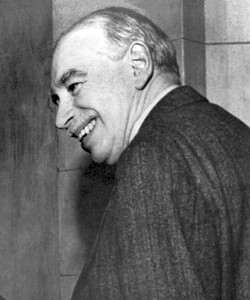
Having recently reread Richard Heilbroner's hoary old monograph, "The Worldly Philosphers", I come armed with wisdom for these bleak economic times, not unlike Don Quixote, astride his faithful Rocinante.
Perhaps at the end of the day, historians of economics will come to view John Maynard Keynes as the Einstein to Adam Smith's Newton. Undoubtedly Smith's law of supply and demand will always enjoy the central stage of economics, just as Newton's laws of motion do for physics. But might I gently remind the dear reader that Newton's laws are wrong (however undetectable that may be for human speeds and masses). So too, Keynes found major flaws in the optimistic dynamics and equilibrium implied by Smith, and hence could be the most important and consequential economist since.
Perhaps the key to his work lies in the re-conception of savings. For a long time, the saving of money was considered an unmitigated private and public virtue; a habit that redounds multipliers on the foresighted family or state, without a doubt.
Not so for Keynes! The act of saving, removes wealth from circulation. That money under the mattress is no longer spent on goods and services that contribute to someone else's income. That someone else, too has less income to spend, so the effect multiplies. If everybody stashes too much of their earnings, the national income plummets and a depression sets in.
"Wait wait," you say, "Now just how does depression settle in so comfortably and uninvited?" Well I ask you to consider the lowly widget factory: The widget factory sees a drop in demand, because people have decided to save their money rather than spending it on widgets. So the factory is forced to lay off some of its employees and cut the pay of still others. Moreover, in order to make ends meet, the CEO decides it is necessary to reduce investment in promising new widget technologies, especially considering that it is unkown how long this savings binge will last. This contributes to a general decline in investment which throws the investment-savings differential still further out of whack and the wheels come off of the economy as it loses its unplanned Smithian efficiency. Prices and inflation rise and all hell breaks loose, in the academic vernacular.
Hence we come to the Bush Administration's much maligned encouragements after 9/11 to go out and spend money. Perhaps this was a strange thing to say at the time, but it was rooted in a belief in Keynesian economics: that a sudden clenching of the pocketbook might lead to depression.
So stashing money under the mattress is a surprisingly bad thing indeed. Tisk tisk! But not quite as bad as all that, is putting it in the bank. The bank takes your money quite happily and lends it out as new investment capital, with interest. Thus, your money finds its way back into circulation, and joins the happy cycle of income to income, and all is well with the world.
Or is it? What happens when there is too much money in the bank? There are simply not enough investors applying for loans. What if the differential between investment and savings is huge and sudden? Pop! The bubble bursts. National income plummets and depression sets in. So even with the cool invention of banks, trouble can be had under the right circumstances.
"Okay, but could this actually happen?" says my imaginary reader; the one who, for some strange reason, has not yet wandered over to her Google, Facebook or Twitter account. Well Keynes says it can and does happen. Growth happens in spurts as new markets rapidly mature and saturate. Take the internet for example. The bubble burst in the late 90's as there was an over-investment in fiberoptic cable and the market saturated. Investment dropped precipitously as there was no longer any reason to lay new cable. This is a repetition of what happened with railroads, autos, and other markets.
So what is to be done? Are we fated to suffer the indignities of boom and bust? Besides not having a clue, this post is getting long in the tooth, so lets save it for the sequel. Anyways Rocinante is getting thirsty.
Saturday, March 21, 2009
A Few Thoughts on Race
Hi. I am French-Canadian-Italian American. I live in the melting pot, where every color blends to enrich the collective tapestry. But color still seems to stain the individual.
Barack Obama is a living example of American color-sensitivity. We always believed that someday a black man would be elected President and that that occurrence would enforce our lauded ideals of equality. That black man just had to be one of the brightest men in his generation with a top-notch campaign team, following on the administration of one who may be easily be one of the farthest below average intellects to be found among the white elite class with the irony found only in real life. Oh, and Obama's blackness is first-generation African American, not the blackness of the descendants of people who carried the shame of slavery. That stain will remain through centuries, it seems. (Sorry, Jesse Jackson.)
French-Canadians and Italians, among emigrants of many other nationalities, flooded into America in the early 20th century. They lived in cultural enclaves which nurtured their entry into a new society. Many of them did jobs that native-borns didn't want; they were poorly paid. Though they probably did not suffer the inequalities of being black in America, neither were they white. This country has been ruled by Anglo-Americans for most of its existence, and those of Mediterranean complexion or the Catholic faith were not accepted to that strata of seraphim. I am off-white.
There are so many colors of American (something the producers of American cheese don't seem to have realized). These past few years I have listened to American accents fall from the lips of brown-skinned people from countries new to American emigration, and felt a tiny thrill that these people are American, new threads in a fading tapestry. Their blood will invigorate a breed which has seen many generations of close intermingling.
Barack Obama is a living example of American color-sensitivity. We always believed that someday a black man would be elected President and that that occurrence would enforce our lauded ideals of equality. That black man just had to be one of the brightest men in his generation with a top-notch campaign team, following on the administration of one who may be easily be one of the farthest below average intellects to be found among the white elite class with the irony found only in real life. Oh, and Obama's blackness is first-generation African American, not the blackness of the descendants of people who carried the shame of slavery. That stain will remain through centuries, it seems. (Sorry, Jesse Jackson.)
French-Canadians and Italians, among emigrants of many other nationalities, flooded into America in the early 20th century. They lived in cultural enclaves which nurtured their entry into a new society. Many of them did jobs that native-borns didn't want; they were poorly paid. Though they probably did not suffer the inequalities of being black in America, neither were they white. This country has been ruled by Anglo-Americans for most of its existence, and those of Mediterranean complexion or the Catholic faith were not accepted to that strata of seraphim. I am off-white.
There are so many colors of American (something the producers of American cheese don't seem to have realized). These past few years I have listened to American accents fall from the lips of brown-skinned people from countries new to American emigration, and felt a tiny thrill that these people are American, new threads in a fading tapestry. Their blood will invigorate a breed which has seen many generations of close intermingling.
Hammer of the Infants
Without doing any research other than what I've heard on NPR all week, this is the basic information I would like to comment on: Henry Paulsen and Timothy Geitner have between them given AIG $170 billion from Treasury; the employment contracts of a number of AIG employees include year-end bonuses totaling something like $164 million; these contracts are bound by law to be completed; some of these employees work in the Financial Products division that wrote the innovative policies which lost so much money for the company after the recent downturn in the housing market; one thousand millions is equal to one billion. After a few calculations, I find that AIG is paying out .0968%, or roughly .1% of the money it received from the federal government in employee bonuses.
Now, I'm not sure if Congress has yet passed a bill discussed this week taxing 90% of the bonuses of a select group of people, but there certainly seems to be widespread support for such a bill, judging from the wrathful geyser of threats and "suggestions" from members of Congress that the employees in question hang themselves, fall on their swords, etc. Instead of questioning where the majority of the bailout money ($350 billion+) has gone to, our elected and constantly-vying-for-re-election Congress has decided to focus its attention on a speck of dust on the foot of the elephant which threatens to uproot the national economy. They will pursue the question of whether this despoilment is removed with all the tenacity of people who are used to spending unimaginable quantities of other people's money, some of whom are not yet born, and then congratulating themselves for their own swift and decisive actions on national television.
Do you think this is what the people we like to call our forefathers envisioned as they dumped bales of British tea into Boston Harbor? Were they not protesting their own victimization at the hands of a monarch determined to make a select segment of his subjects pay for the actions of the state, i.e. the recent war with the French? What strange irony that this nation, in what we like to think of as its ripe maturity, will become the taxing tyrant we once despised.
This uproar is as rich as the one a few months ago when the heads of American auto flew to Washington in their corporate jets. Since they fly everywhere else in their corporate jets, and have done so for years unquestioned, Congressional outrage at their doing so during a financial crisis seems trivial. No one wanted to address the issue of whether the auto companies were too large, too powerful, too wasteful, until it came to their symbolic use of corporate jets. It seems to me that if Congress has a problem with the way things are done in Detroit, that body certainly has some dictatorial power these days to change those things. I wonder if it will.
When did our Congress become the last and highest court of all things American? I thought we already had one of those, proscribed in the constitution. To my chagrin, I find that the forefathers aforementioned included in that document a power of Congress "to constitute tribunals inferior to the supreme Court", so I guess that gives Congress the leeway to interrogate suspected Communists and regulate Terry Schiavo's machine-assisted life, among a multitude of other things they choose to involve themselves in.
Now, I'm not sure if Congress has yet passed a bill discussed this week taxing 90% of the bonuses of a select group of people, but there certainly seems to be widespread support for such a bill, judging from the wrathful geyser of threats and "suggestions" from members of Congress that the employees in question hang themselves, fall on their swords, etc. Instead of questioning where the majority of the bailout money ($350 billion+) has gone to, our elected and constantly-vying-for-re-election Congress has decided to focus its attention on a speck of dust on the foot of the elephant which threatens to uproot the national economy. They will pursue the question of whether this despoilment is removed with all the tenacity of people who are used to spending unimaginable quantities of other people's money, some of whom are not yet born, and then congratulating themselves for their own swift and decisive actions on national television.
Do you think this is what the people we like to call our forefathers envisioned as they dumped bales of British tea into Boston Harbor? Were they not protesting their own victimization at the hands of a monarch determined to make a select segment of his subjects pay for the actions of the state, i.e. the recent war with the French? What strange irony that this nation, in what we like to think of as its ripe maturity, will become the taxing tyrant we once despised.
This uproar is as rich as the one a few months ago when the heads of American auto flew to Washington in their corporate jets. Since they fly everywhere else in their corporate jets, and have done so for years unquestioned, Congressional outrage at their doing so during a financial crisis seems trivial. No one wanted to address the issue of whether the auto companies were too large, too powerful, too wasteful, until it came to their symbolic use of corporate jets. It seems to me that if Congress has a problem with the way things are done in Detroit, that body certainly has some dictatorial power these days to change those things. I wonder if it will.
When did our Congress become the last and highest court of all things American? I thought we already had one of those, proscribed in the constitution. To my chagrin, I find that the forefathers aforementioned included in that document a power of Congress "to constitute tribunals inferior to the supreme Court", so I guess that gives Congress the leeway to interrogate suspected Communists and regulate Terry Schiavo's machine-assisted life, among a multitude of other things they choose to involve themselves in.
Thursday, February 19, 2009
Of shoes and presidents
There is some breaking news in the case of journalist Muntadhar al-Zeidi, that courageous hero who threw not one but both of his shoes at the oat-filled head of George Bush. Here it is:
Iraqi says he threw shoes at Bush to protest war
al-Zeidi shouted in Arabic as he discharged his fusillade.
Both the thrower and the throwee displayed a surprising dexterity as both shoes were aimed perfectly and Bush dodged each of them with equal agility.
quipped Bush (in English).
Herewith I propose making it an annual event. December 14th will be International Shoe-Lobbing Day. And may I propose that Robert Mugabe be the next target.
Iraqi says he threw shoes at Bush to protest war
"This is your farewell kiss, you dog! This is from the widows, the orphans and those who were killed in Iraq."
al-Zeidi shouted in Arabic as he discharged his fusillade.
Both the thrower and the throwee displayed a surprising dexterity as both shoes were aimed perfectly and Bush dodged each of them with equal agility.
"All I can report is a size 10"
quipped Bush (in English).
Herewith I propose making it an annual event. December 14th will be International Shoe-Lobbing Day. And may I propose that Robert Mugabe be the next target.
Sunday, February 01, 2009
2009 - the future is now?
Here we are in 2009 by Gregorian reckoning. A decade ago, the wunderkind inventor Ray Kurzweil made some rather astonishing predictions about the course of technology to come in his book The Age of Spiritual Machines.
Here is a quick recap: Technology will grow exponentially (like Moore's Law for computers) and quickly surpass and then actually replace the human mind. Humans will become immortally detached from their bodies, swimming in a virtual world of artificial companions.
On the way to this blissful future, Kurzweil offers a timeline of what will transpire, in 10 year increments beginning with the year 2009.
Kurzweil is not without his critics. In this interview, the well known cognitive scientist Douglas Hofstadter names Kurzweil's increments as excrements:
Here are Kurzweil's 2009 forecasts:
Are we there yet?
Here is a quick recap: Technology will grow exponentially (like Moore's Law for computers) and quickly surpass and then actually replace the human mind. Humans will become immortally detached from their bodies, swimming in a virtual world of artificial companions.
On the way to this blissful future, Kurzweil offers a timeline of what will transpire, in 10 year increments beginning with the year 2009.
Kurzweil is not without his critics. In this interview, the well known cognitive scientist Douglas Hofstadter names Kurzweil's increments as excrements:
If you read Ray Kurzweil's books and Hans Moravec's, what I find is that it's a very bizarre mixture of ideas that are solid and good with ideas that are crazy. It's as if you took a lot of very good food and some dog excrement and blended it all up so that you can't possibly figure out what's good or bad. It's an intimate mixture of rubbish and good ideas, and it's very hard to disentangle the two, because these are smart people; they're not stupid.
Here are Kurzweil's 2009 forecasts:
A $1,000 personal computer can perform about a trillion calculations per second.
Personal computers with high-resolution visual displays come in a range of sizes, from those small enough to be embedded in clothing and jewelry up to the size of a thin book.
Cables are disappearing. Communication between components uses short-distance wireless technology. High-speed wireless communication provides access to the Web.
The majority of text is created using continuous speech recognition. Also ubiquitous are language user interfaces (LUIs).
Most routine business transactions (purchases, travel, reservations) take place between a human and a virtual personality. Often, the virtual personality includes an animated visual presence that looks like a human face.
Although traditional classroom organization is still common, intelligent courseware has emerged as a common means of learning.
Pocket-sized reading machines for the blind and visually impaired, "listening machines" (speech- to- text conversion) for the deaf, and computer- controlled orthotic devices for paraplegic individuals result in a growing perception that primary disabilities do not necessarily impart handicaps.
Translating telephones (speech-to-speech language translation) are commonly used for many language pairs.
Accelerating returns from the advance of computer technology have resulted in continued economic expansion. Price deflation, which had been a reality in the computer field during the twentieth century, is now occurring outside the computer field. The reason for this is that virtually all economic sectors are deeply affected by the accelerating improvement in the price performance of computing.
Human musicians routinely jam with cybernetic musicians.
Bioengineered treatments for cancer and heart disease have greatly reduced the mortality from these diseases.
The neo-Luddite movement is growing.
Are we there yet?
Thursday, January 22, 2009
Jeff's Diary: January 20th 2009
0600 – Alarm goes off, I hit snooze. Pentagon Center Georgetown 6pm situation. I have a $20 parking ticket the next day to tell me I really wasn’t dreaming everything that happened the day before.
[PS. I would have included video, but apparently this blog site interface sucks - it won't properly upload videos ]
SEE FLICKR for the complete photo trail...
0617 – OK I’m moving…
0650 – Armed with cameras, warm clothing, chapstick, etc, and my formal attire for later, I nervously drive my car, aka mobile locker, towards Objective #1: place to park in neighborhood near Foggy Botom metro line. The City is not exactly bustling, but people are walking, biking, and on the phone in moderate numbers.
0710 – Bingo! Good parking spot only 4 blocks from metro. I leave everything in my mobile locker except cameras and "survival" gear. Phone Angela as I head to metro to see how she is doing regarding our rendezvous pt at 3rd &
0730 – Oh my…after waltzing into the metro, even with not too many people on platform (yet), the first train that arrives is jammed in mad fashion; few people on platform able to board.
0735 – Second train comes jammed like first but I literally squeeze into doorway. Lots of people got on this thing way far out. Train is so full you don’t need a handhold despite lots of jerking due to abnormal slowdowns, stops & starts. Delays start to add up due to difficulty getting the doors closed at each stop. People are either asleep if they have a seat or chatting excitedly and making jokes. Can barely get my camera out to snap a couple photos because its so cramped.

0815 – So far so good. Reached Objective #2:
Oops. Platform is so packed with people getting off trains it takes forever just to exit. Metro authority opens the gates to keep it moving. (Now my metro card will be confused next time I use it.). There are not enough police/metro officers to smoothly orchestrate the exodus.

0841 – Daylight! Angela can’t make rendezvous point and neither can I. Following directions from smiling red-hatted volunteers, I head to 7th &
0850 – Curses…
0920 – Going gets more and more crowded…slows down around 12th st. Inching along now in a throng that is alternately bottlenecked between parked buses and outer Mall fencing and security people and whatever else. Slowly reach the first and then the second of the two arches stretching overhead from the Dept of Agriculture building. Can’t even seen the Mall or the Capitol. People pour onto


0945 –
0955 – Ha-hah! I slither through people forming up against 15th street, which is the one crossing the Mall in front of the Washington Memorial. There is an ocean of people rippling about the Memorial as far as the eye can see.

There are still enough open holes for me to make it about 1/3 of way to centerline between Memorial and Capitol. I’m on a slight downslope about 4 meters from the edge of

1125 – Officials and VIPs starting arriving at the Capitol, according to the TV and speakers. People have completely filled in behind me. There is some getting to know people around you as we all wait and wait. Any little disturbance to the status quo in the neighborhood (someone trying to push further, etc) stands out like a sore thumb and is suppressed. A wind chaffed and very-white pair in late 20s or early 30s from
1145 – Every time the younger Bush appears on TV, and especially at introduction, there is mass booing. The vibe is at least as hostile regarding Cheney. Even Bush Sr. gets booed. I discuss the possibility with someone that this may be simply for raising George W ? Mostly there is a positive pro-Obama vibe, but there are a few anti-Bush banners and signs. Carter looks very old but moves well. Bush Sr is dottering. Speaking of which, a stumbling, fainting woman appears, we help her smear through the crowd the 4 meters to get to
1200 – Obama is officially President at
1325 – The crowd starts to break up little by little like a springtime thaw. Strangely, there were busloads of people departing the mall via

Others head for the exits…which are poorly designed in my opinion. Everyone is forced west towards the Lincoln Memorial instead of being able to exit north. Objective #4 for me is to meet Angela at the Anheiser-Busch party right on the north corner of the Capitol at
1400ish – Made it to Farragut West Metro. Crowds are loose and getting on the metro is easy compared to earlier. A lot of people are going into restaurants or probably situating for the parade. I go a few stops easily enough, including a transfer, to
1445 – Success!!! Seemingly random security barriers are just beyond

Angela never made it through security even with a ticket and ultimately walked around the back of the Capitol to get here. We both had to acknowledge that this would have been the simplest and best plan to just come here from the start. Oh well. Snacks are tasty, the beer is cold, and did I mention the view? Whether wimping out behind the huge windows or out on the roof, wow. I am starv-acious after not eating since 0630 oatmeal.


1525 – Finally. The parade is late getting started. Part of it may have had to do with Senator Ted Kennedy needing an ambulance. The parade includes lots of police sidecar motorcycle things that look like graphics from the old space invaders or galaga arcade game. I finally have a chance to use my telephoto to snap Obama. A few minutes after he passes our building, he and Michele get out walking and waving! Damn the luck, no photos possible, I’ve gotta get to a Ball and Angela has a plane to catch back to

1604 – We leave the party, only to find the
1630 – I made it! But…exiting the platform at Foggy Bottom there is a huge line trying to get into the station and I surmise that I need a plan B for Objective #5:
1650 – Emerge from bathroom in Air Force mess dress much to the delight of girls working behind the counter. Another girl wants to know about my medals but I have a Ball to get to.
1725 – Arrive Pentagon Center via my car, only needing to circumvent one blocked off exit. Remember, I don’t know this city to well yet. Only driven here once. Miraculously, Georgetown M Street and the
1808 – I meet my date Shawn in the lobby of here high rise condo.

She helps me do emergency repairs on a shoulder board photos button pop-off a few minutes earlier and a broken bow tie. We take some photos and off we go on the yellow line metro…back to what is becoming my favorite station:
1915ish – There is no authorized coat or really any sort of accounting for cold weather with the mess dress. It’s a cold walk to the 
And the venue is glorious. Massive pillars, long pale veils of hanging translucent gauze, red, blue, gold, and white lighting. A mix of Roman coliseum, Louis XIV and a Chinese Buddhist temple. There’s food, drinks, music, dancing, all the rest.


Attendance is mostly military, heavy on junior enlisted and some junior officers, purportedly based on direct admonishment from Obama that this was not to be a VIP colonel and general party. Speaking of which, I tap Shawn when I see 4 stars on a man’s shoulder boards and she identifies the new Chief of Staff of the Air Force (19th one), General Norton Schwartz. He’s amazingly personable.

2100ish – The Vice President arrives to talk to the troops. Very warm, very excited appearance. He engages via satellite with half a dozen troops overseas who are on big screen TVs. His wife appears and they dance briefly on the catwalk before retiring. It is interesting being at the corner of the podium and seeing the security folks in action.

Meet some interesting people (besides my very cool date, an Air Force reservist who spent the day on the Capitol steps, no less, escorting VIPs during the swearing in): An black veteran who was in the Navy in the Pacific front during WWII – and ALSO switched to the Army and went to the Western front. Before he retired in 1970 he was in
1015ish – Jon Bon Jovi has to interrupt his gig when The President arrives. He is perhaps 20 meters away. He doesn’t look tired. A rousing talk and another satellite hookup to overseas troops. This time when he and Michelle dance on the catwalk, they also dance with a guy and girl from one of the services. The Marine Band is in fine form. Everyone has a camera going, including me, thanks to Erica lending her sleek little Canon elph.


1200 – Smokey Robinson sounded great. The party is over and we grab cups of hot chocolate before making a run for
1245 - Unbelievable, the metro is really busy. Not quite like in the morning, but more than the afternoon and evening. People are very interested in us and our uniforms. Maybe I should wear mine around more often.
1345 – After getting Shawn back to her place in[PS. I would have included video, but apparently this blog site interface sucks - it won't properly upload videos ]
SEE FLICKR for the complete photo trail...
Subscribe to:
Posts (Atom)

 Posts
Posts


